| Bibliography Accidentally
Fictional - First Officer Joseph Murdoch and
Third Officer Boxy SOS Titanic (1979) and Titanic (1996) |
| One could well question whether First
Officer 'Joseph' Murdoch and Third Officer 'Boxy'
qualify as proper fictional officers. One came
into being no doubt as an error and the other to
simplify the tale. Both have only tiny parts to
play in the films they appear in, and a viewer has
to be very well versed in the story of the Titanic
and her officers to spot anything off about them.
Nonetheless, I include them, for the sake of
completeness and because it's what nitpicky
Titanic buffs do for fun. |
| Joseph Murdoch - William
Murdoch's Secret Twin Brother? SOS Titanic (1979) SOS Titanic1 was made in 1979, more than twenty years after A Night to Remember. This long period of time in which no film about the 'ocean's greatest disaster' was made is a clear indication of just how influential A Night to Remember was. It seems that there was very much a 'been there, done that' feeling around: the story of the sinking of the Titanic had been told and needed no further elaboration. Similarly, the huge success of Cameron's Titanic ensured that with the exception of the spoof Titanic II, the next retelling of the Titanic's story was the TV series made 15 years later to coincide with the centenary of the sinking of the Titanic. There are of course great differences between the A Night to Remember and SOS Titanic. While A Night to Remember focuses to a considerable extent on Charles Herbert Lightoller and representative members of passengers and crew, SOS Titanic concentrates very much on three couples: John Jacob and Madeleine Astor from first class, Lawrence Beesley and Leigh Goodwin, an American lady he befriends, in second class. and a number of steerage passengers. |
| As the film recounts the story of
the Titanic disaster, the officers of
the ship are present, but they are very much
reduced to an amorphous group in the background. The first officer shown in SOS Titanic could very easily be mistaken for a reasonably faithful rendition of the Titanic's first officer Murdoch. His role is very much in accordance with earlier (and later) renditions of his part. He can be seen doing all the things we expect Murdoch to do: he can be seen in the company of the other officers trailing in the wake of the Captain, he takes over the watch from Lightoller at 10 pm on Sunday night, he unsuccessfully attempts to avoid the iceberg, loads and lowers life-boats, and, alongside Chief Officer Wilde, watches as Bruce Ismay gets into a life-boat. |
| However, unlike the real first
Officer of the Titanic, the officer in
this film has a moustache. (Admittedly, Murdoch
had had a moustache earlier in his life, but it
had gone for several years before he sailed on
the Titanic.) This may be regarded as a such a small discrepancy to not be worth mentioning. After all, the appearances of the characters do not bear any striking resemblance to the historical people, the fashion in the film owes much more to the 1970s than to the 1910s. Madelaine Astor looks like a lost hippie while J. J. Astor looks very much like a latter-day version of Abraham Lincoln. The first officer in the film is however called Joseph Murdoch, while the first name of first officer of the real ship was William.2 A simple mistake – or does this film reveal that there was a lost twin brother? |
| Perhaps there is another
explanation: As we learn in Star Trek
(original series, episode 'Mirror, Mirror') and
also from South Park there is a parallel
universe, close to ours, and it is possible for
the inhabitants of one universe to enter the
other. The only way to distinguish between those
from the parallel universe and ours is that
people from this other universe often sport
facial hair while their counterparts from this
one do not. In SOS Titanic it is not only Mr Murdoch who has a moustache, Col. Astor sports a beard he never had in real life, and Joseph Boxhall, fourth officer seems to have grown a moustache too. Is SOS Titanic in fact a film set in a parallel universe? Unfortunately, amusing as this theory is, the real reason behind this mystery is presumably that somebody responsible for the script just simply made a mistake. Perhaps he confused the first names of Boxhall and Murdoch. Perhaps it was even only the person responsible for the credits who mixed names up. One interesting factoid about SOS Titanic is that David Warner, who plays Lawrence Beesley, has since travelled on the Titanic a second time: in Cameron's Titanic he portrays Cal Hockley's sinister manservant Spicer Lovejoy. While the real Lawrence Beesley did not manage to go down with the ship the second time round (during the filming of A Night to Remember), David Warner did the second time he played a character travelling on the Titanic. |
1. SOS Titanic was released both as a TV miniseries and in abbreviated from as a film. I have only seen the film. So far. |
|
|
| Officer Boxy - Two for the
Price of One Titanic (1996) |
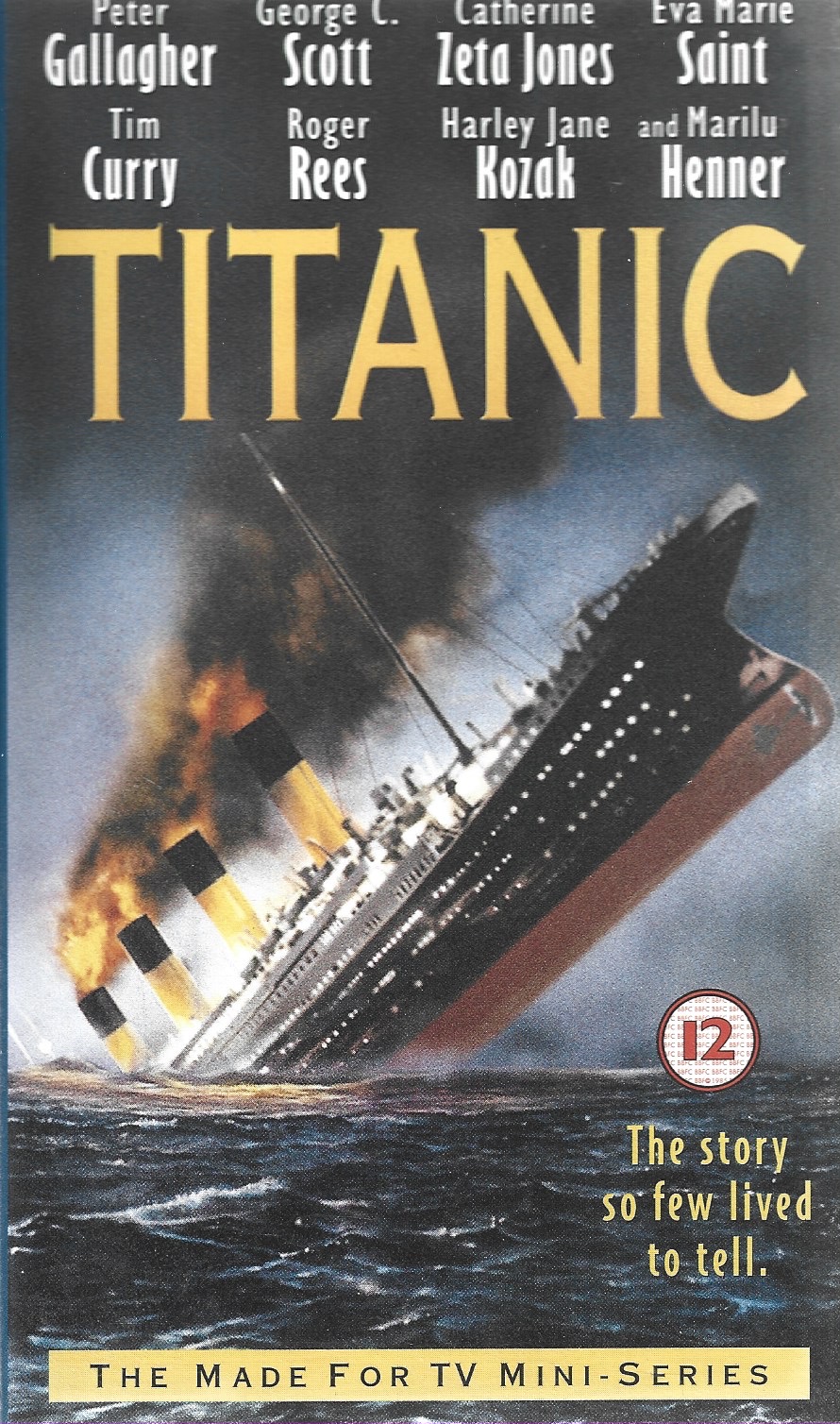 Cover of my video |
|
Just as the Titanic has
a lesser well-known elder sister, the
Olympic, who entered her long and
successful service a year before the
tragically short one of the Titanic,
so James Cameron's enormously successful
film was preceded a year earlier by a made
for TV two-part miniseries about the same
subject: the 1996 production Titanic
starring Catherine Zeeta Jones, Peter
Gallagher, George C. Scott and Tim Curry.
Many aspects of the
1996 Titanic are of course
familiar to those, who like me,
enjoy doing a little a 'compare and
contrast'. Like SOS Titanic
it focuses on three couples, the
ill-fated rekindling of romance
between a first class lady, Isabella
Paradine (Zeeta Jones) and her
former lover Wynn Park (Peter
Gallagher), the new romance between
two steerage passengers, Aase
Ludvigsen and Jamie Perse, and the
Allisons and their troubled nurse
(whose behaviour, as well as that of
Mrs Allison, is depicted as being
responsible for the death of the
only first class child lost,
Lorraine Allison). The parallels
between the miniseries and Cameron's
film, beyond the fact that both
retell the same event, is so
startling that it has been
speculated that Cameron's script had
been leaked to the writers of the
miniseries.
|
|
In the 1996 Titanic
miniseries there seemed to be, however, a
shortage of staff. Not only does Thomas
Andrews not make his traditional appearance
in this film (his part of announcing the
ship's death sentence is taken over by
Captain Smith) there is also no sign of
Chief Officer Henry Wilde or Third Officer
Herbert Pitman.
Only nitpicky people
like myself will notice that another
officer is actually the amalgamation
of two men, fourth officer Joseph
Groves Boxhall and sixth officer
James P. Moody. He is billed as
Boxhall, but since he is on the
bridge when the ship hits the
iceberg, he is taking over Moody's
role here. Therefore, a friend of
mine and I decided the person in the
film was actually Officer Boxy.
|
|
Combining several people into
one is relatively common in historical
movies, and often can helps those viewers
with no previous knowledge of the subject to
be able to understand the plot. In the 1996
film Michael Collins Ned Broy and
David Neligan, the 'Spy in the Castle', were
combined into Ned Broy, the film's 'Spy in
the Castle'. The contrary case is Kevin
Costner's Wyatt Earp (1994). The
sheer number of characters in the film means
that many viewers cannot recall who is who
and consequently care less about those
peoples' fates. An extreme example is Johnny
Ringo whose name is first heard when he is
shot dead. However, since the officers play
only a very small part in the miniseries Titanic,
it would have hardly mattered whether there
had been two of them standing about in the
background instead of one.
Whatever the
reason, they accidentally created another fictional
officer: Officer Boxy.
|
| Back to Fictional Officers of the Titanic |